by George Chauncey
Resources on Gay Marriage |
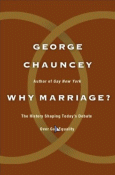
| Why Marriage? The History Shaping Today's Debate Over Gay Equality by George Chauncey | |
| New York: Basic Books, 2004. 200 pp. ISBN 0-465-00957-3. $22.00 Gay marriage is a hotly debated issue today, pitting Gays and Lesbians at one extreme against religious conservatives at the other. Many Gays and Lesbians, on the one hand, believe that the view of marriage as being between one man and one woman is one of the last bastions of legal prejudice—like the last Whites-only country club—that devalues and discriminates against Gays and Lesbians. The denial of equal recognition seems to say that Gay and Lesbian relationships are second-class relationships, not as good as those of heterosexuals and thus not deserving of the financial benefits and special considerations that heterosexual relationships are awarded by the government, making marriage a legal institution (for a detailed discussion of the special privileges awarded to heterosexual relationships, see Kotulski, 2004). Many religious conservatives, on the other hand, draw on fundamental religious views to define Gay and Lesbian relationships as inherently sinful, citing Old Testament injunctions. Others believe that marriage is a sacred religious institution, formed for the purpose of conceiving and raising healthy children. With this reasoning, heterosexual relationships contribute to the continuation of society in a fundamental way and thus deserve the special treatment by the government because it is in the government's best interest to protect and support heterosexual families. Also according to this reasoning, because Gays and Lesbians in relationships cannot conceive children together, their relationships are second-class to heterosexual ones, making marriage a religious institution. Chauncey's book about Gay marriage is a thoughtful account that begins before the conflict today. The author starts with a short historical review of prejudice against Gays and Lesbians, highlighting the "demonization" of "homosexuals" (pg. 18) and pervasive efforts in past decades to present Gays and Lesbians as a "formidable and invisible conspiracy" (pg. 19) with a "corrosive influence" (pg. 20) in America. At times referencing his earlier book, Gay New York, he argues that widespread prejudice against Gays and Lesbians was primarily initiated by government leaders and religious groups. Gays and Lesbians were denied the right to congregate and to access certain jobs, and they were routinely arrested, confined, and sometimes subjected to psychiatric evaluations. Chauncey cites a 1924 incident in which a man formed what was the first Gay rights group; police broke into his home, arrested him, and stole the group membership list. Thus, the legal discrimination and mistreatment of Gays and Lesbians predates the marriage debate by several decades. Chauncey continues by detailing some of the progress of other rights movements, clearly casting Gay and Lesbian marriage as a civil and legal right. From the United States' view of minority rights in other countries after World War II in the late 1940s to the Black civil rights and feminism movements in the 1960s, Chauncey traces how other groups confronted prejudice that was often strongly supported by the religious right. Chauncey argues that religious groups strongly opposed interracial and interfaith marriages, for example, and cited arguments that today would be considered racist, and made claims (for example, Anita Bryant) about the welfare of children which have not been upheld. Freedom to marry someone of a different ethnic group or religion became a civil right, despite the claim that marriage was primarily a religious institution that should be controlled by religious groups. Chauncey notes that on the basis of other groups' partially successful press for equal rights, the Gay rights movement learned to enlist the aid of professionals to destigmatize Gays and Lesbians and learned to seek assimilation into mainstream straight culture, combating those who recast equal rights as special rights and privileges. This became more and more salient of a divide, given that Gays and Lesbians sought equal rights while heterosexual couples received special rights, such as increased financial security and compensation, greater access to health care and protection for the family unit, and special tax exemptions and government exceptions. Chauncey offers that Gay marriage naturally came to the forefront as the next area of civil rights in which Gays and Lesbians should seek equality, especially for Gays and Lesbians with children. In the final chapter, Chauncey shifts from historical analysis to modern-day events and presents real stories from Gays and Lesbians seeking marriage. Their comments and thoughts make clear that they see Gay and Lesbian marriage as more than a civil union that might (or might not) bestow some legal protection through a separate but equal status. To these people, rather, marriage conveys a social validation and true equality. Recognition of Gay and Lesbian marriage is recognition that Gays and Lesbians can and do make the same cornerstone contribution to society as heterosexuals, which thus affirms the equal value of Gays and Lesbians as members of society. Chauncey points out that those opposing Gay marriage echo the same dire warnings that political and religious leaders of the past voiced in response to the changes brought about by feminism, interracial marriage, and civil rights: The "natural order" of society will be overthrown, the basic structure of the family and community will be irrevocably damaged, and "God's will" is known and clearly in disagreement with these changes. Chauncey points out that, with time, society recognized that these arguments were tools of prejudice and control and that society has largely shifted away from these beliefs. Today, many in the religious community and the government seek to forget their active role in the past in promoting and reinforcing prejudice and control; in doing so, they hope to claim a higher moral ground from which to state their objections to Gay and Lesbian marriage as new and different objections. However, Chauncey offers, their arguments have not changed, and their dire warnings continue to serve the same purposes they have for the last 40 years. References Chauncey, G. (1994). Gay New York: Gender, urban culture, and the making of the gay male world 1890–1940. New York: Basic Books. Kotulski, D. (2004). Why you should give a damn about Gay marriage. Los Angeles: Advocate Books. Richard Niolon is an Associate Professor of the Chicago School of Professional Psychology. He obtained his PhD from Saint Louis University, after which he began private practice in Chicago focusing on families and couples. His assessment work has included parental capacity and custody evaluations. His therapy work has been with Gay and straight individuals and couples, both in traditional theoretical models (Bowenian), as well as newer models (Gottman's Sound Marital House). His professional interests include cohabitating couples, divorce, remarriage, and domestic partnership rights. He is also Webmaster of PsychPage.com. |