by Jerry J. Bigner and Joseph L. Wetchler (Eds.)
Resources on Gay Marriage |
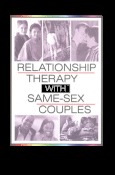
| Relationship Therapy With Same-Sex Couples by Jerry J. Bigner and Joseph L. Wetchler (Eds.) | |
| Haworth Press, 2004. ISBN 078902554X. $40.00 As more and more same-sex couples form, seek marriage, parent children, grow old together, and even end their relationships, a thorough understanding of same-sex couples becomes crucial to clinical practice. However, understanding same-sex couples has become important not only to psychologists, but also to religious leaders and politicians who debate "gay marriage" versus "civil unions," and to average Americans who live, work, pray, and vote alongside same-sex couples. Thus, Bigner and Wetchler's work is highly relevant to current events and concerns in both our field, and our society at large.This docuserial is a collection of 13 previously published articles, selected by Bigner and Wetchler, which together serve as an excellent primer on same-sex couples work. It begins with a foreword by Robert-Jay Green, who spells out in simple terms (for the reader who may be new to these issues) how legal, cultural, and social factors combine to make work with same-sex couples very different. The book continues with articles that consider therapy with gay and lesbian couples together as well as separately, that are based on research as well as personal experiences, that cover reactions by couples as well as by therapists, and that cover special topics including sex, parenting, and the breakup of opposite-sex relationships when one partner comes out. It is the variety in the way same-sex therapy issues are considered and in the content in the articles that makes this such a good primer on couples therapy with same-sex couples. The first selected article is a short and basic introduction explaining how forces of societal oppression, mainly homophobia and heterosexism, impact same-sex couples. This is followed by a couple-focused discussion on discrepancies between partners in the coming out process, cultural differences between partners, and issues in relating to family-of-origin versus family-of-choice. By highlighting both social forces and couple-focused differences, the collection makes clear that same-sex couples are highly variable and flexible in their presentation and functioning. Building on this theme, the next two articles are separately devoted to issues for gay and for lesbian couples. These are followed later by two articles separately devoted to sex therapy with gay and lesbian couples. These articles include a review of key issues, such as management of individual versus couple boundaries, and having open and informed discussions about a couple's sex life. For heterosexual counselors, in my experience, same-sex versus opposite-sex couple differences in relationship formation, intimacy, and sex are often the most surprising, emotionally confusing, and discomforting aspects of work with this population. Bigner and Wetchler have selected articles that provide a basic exposure to normative behavior, struggles, and stages, with case examples and reflective material, making the collection especially helpful. The articles on sex therapy deserve special note, however. Gurman and Fraenkel (2002), in their millennial review of couples therapy, note that sex therapy has traditionally been left out of couples work. The assumption has been that an improvement in the level of intimacy for the couple would automatically result in an improvement in the satisfaction with their sex life. This has not always been the case, Gurman and Fraenkel (2002) note, but the lack of training in sex therapy for most couples therapists left them with few other options for treatment. Thus, to see two articles of this work devoted to sexual issues in gay and in lesbian couples marks this work as a more modern and up-to-date collection. While including articles considering gay and lesbian couples separately would be expected in a basic collection of works, Bigner and Wetchler go beyond this level. They include two more articles that separately consider couples with a bisexual and with a transgendered member, both including case examples. They then include two more articles on gay and lesbian parenting, and the breakup of opposite-sex relationships when one partner comes out. By exposing readers to these issues, the editors again go beyond the basic material, and address issues that are more and more common in modern couples and family work. The editors shift approaches at this point in the collection, taking the focus off of same-sex couples, and turning their attention specifically to reflection for therapists. They include works describing one gay man's reflection on his experiences with multicultural relationships, another on dealing with homophobia and heterosexism in the training of same-sex couple therapists, and another on the therapist recognizing and dealing with his own feelings of guilt as a heterosexual in a heterosexist world. These articles do a good job of promoting self-reflection, and evaluation of the quality of one's supervision and therapy services. I think the addition of a focus on the therapist's internal processes during same-sex couples work makes the book especially valuable to both therapists and students in training. No collection of issues involved in same-sex couples work could be truly comprehensive. Bigner and Wetchler do omit a number of key issues modern therapists face in their work with this population. These include domestic violence, substance use, and the impact of HIV on the gay and lesbian community. All three are sensitive issues not only because of the seriousness of their impact on the community, but also because all three issues can be used to better understand the community, or to denigrate the community. Thus, knowledgeable and sensitive handling of them is very important in same-sex couples work. Bigner and Wetchler do close the collection with references to additional published and World Wide Web resources for the interested reader. A number of issues that present special challenges in same-sex couples that were left out of this collection are noted here, including domestic violence, gay marriage and the associated legal and political issues, advocacy, and general mental health needs. This section includes several resources that would be helpful as well to same-sex couples not seeking treatment. In summary, this collection offers considerable variety in the way same-sex therapy and same-sex couples are considered, and in the practical information and clinical cases offered. It also stimulates therapist reflection and self-evaluation, and provides additional resources for the interested reader. Overall, it serves as an excellent primer on modern issues in same-sex couples work. References Gurman, A. S. & Fraenkel, P. (2002). The history of couple therapy: A millennial review. Family Process, 41, 199-260. Richard Niolon is an Associate Professor of the Chicago School of Professional Psychology. He obtained his PhD from Saint Louis University, after which he began private practice in Chicago focusing on families and couples. His assessment work has included parental capacity and custody evaluations. His therapy work has been with Gay and straight individuals and couples, both in traditional theoretical models (Bowenian), as well as newer models (Gottman's Sound Marital House). His professional interests include cohabitating couples, divorce, remarriage, and domestic partnership rights. He is also Webmaster of PsychPage.com. |